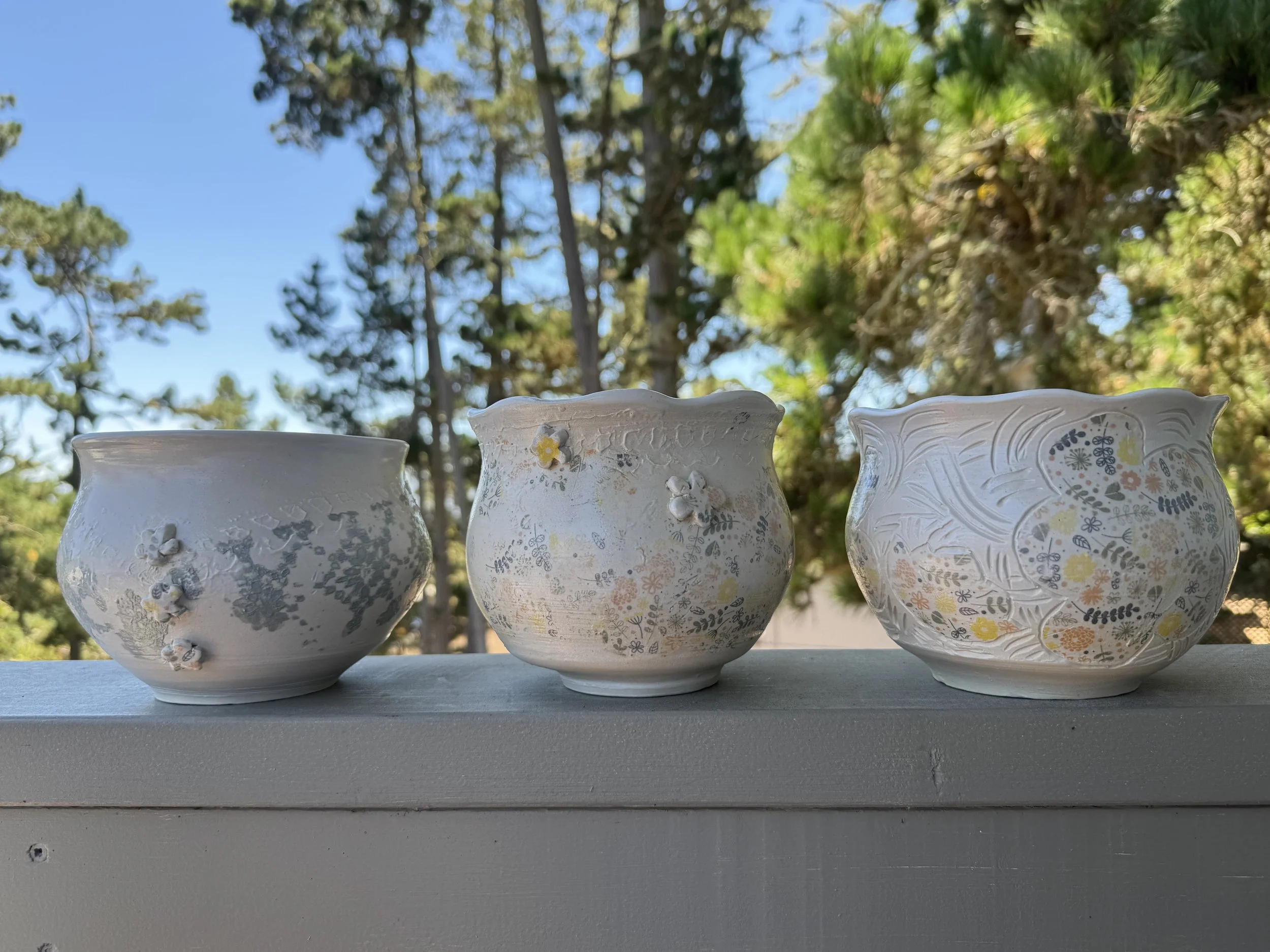
The Ladies: A pot trio inspired by my Grandma Emma
The elegant vase on my potter’s wheel stood waiting for a few final touches. The clay was still wet and pliable, and I planned to finesse its neck and add a little shape to its belly before calling it done. Just as I approached my station, I inadvertently kicked the floor pedal. Whoosh! It was like stepping on the gas going from 0 to 60. In a split second, the unanchored piece flew through the air, ricocheted off a neighboring station, and landed with a thump.
It wasn’t the first time I’d been oblivious to my body in relation to a freshly thrown piece. But this time I hoped for an outcome other than rolling it into a ball to start over again on another day.
“Is it done… as in dead?” I asked my instructor, Mark. He suggested I take it home along with some carving tools and see where it led.
At the kitchen table that evening, through squinting eyes, I let my hands and fingers and a little carving tool reshape its walls into what the vase wanted to become. An asymmetrical pitcher began to emerge with gentle curves, a slightly twisted handle, and a souvenir gash on its side. I loved it, especially because it flowed from pure inspiration into something I never could have imagined.
The next day, buoyed with newfound inspiration, I asked Mark how I could do it again, but in a more intentional way that didn’t require sending something flying first.
He pointed to a freshly thrown pot on my wheel and said, “That’s a nice-shaped pot. Make two more just like it, then line them up side-by-side and see what story they want to tell.”
So I did. And magic happened.
An inner force took over. It led me to some old transfer paper with a vintage floral pattern, which I cut into random flower shapes and applied to the first pot. The second pot asked for more of the same, but with randomly ripped pieces and lighter splashes of color for a more worn and weathered look. Then the third one sent me on a search for my grandma’s hand-crocheted lace, which I snipped off some old pillowcases. The next day I returned to class and stenciled the lace patterns onto the clay.
On and on it went: pots speaking to one another and to me, telling me what they wanted each step of the way. Carving, etching, clay buttons, scalloped rims. I was in the flow of an invisible force, and then I realized I was channeling my grandma, my mom’s mom, Emma Matilda Engebretson Beaudin, aka “Gram.”
Even though Gram passed back in 1990, she had a story to share now.
It was about my female ancestors—a long line of strong, hard-working, independent women who, because of the times, fell into roles requiring them to place their needs, dreams, and desires behind those of their husbands. They were farm women in Minnesota’s rich and fertile Red River Valley. Their days were filled with unending chores, unfathomable responsibilities and expectations, and hot-tempered husbands to boot. Challenges were relentless, physical demands withering, chores unending, pleasures minimal, and affection absent.
But my gram, like the women before her, persevered through her art. She’d call it her handiwork, and it was where she returned each evening. As darkness fell, she’d settle in by the light of a kerosene lamp with her embroidery, crotcheting, knitting, tatting, or sewing. She was a master of all and seemed to create out of thin air. It was her own kind of magic—transforming even the most mundane into something extraordinary.
I remember, as a little girl, arriving at the farm one time without pajamas. Gram whipped out her tape measure, wrapped it around my shoulders and chest, then cut a pattern out of old newspaper. In no time at all, I was settling into bed with a freshly sewn nightie trimmed with lace–and a matching one for my doll.
She and other local farm ladies gathered for sewing bees and craft circles. It was their chance to connect, commune, and otherwise escape for moments of levity and fun. Her handiwork extended into everything she did.
After Grandpa passed, we’d drive hundreds of miles every other weekend to visit. She’d meet us at the car, “Let’s walk around and I’ll show you my flowers.”
Then we’d weave through a maze of randomly sprinkled flower patches, dictated only by where grass wouldn’t grow. They popped with peonies, snapdragons, tiger lilies, dahlias, orchids, and the like. The grand finale of the garden tour ended with her rows and rows of fresh vegetables. It was an outdoor pantry and the recipient of so much pride and joy. Gram would can and pickle to last through the long winter. Her freezer overflowed with apple pies to warm and rolled-paper-thin sugar cookies to gift.
Her story, expressed through this trilogy of pots aptly named “The Ladies,” honors her and the women who came before. It is a tribute to their fortitude, ingenuity, determination, and grit. They played by rules they didn’t write and wouldn’t choose, persevering so future generations wouldn’t have to endure the same. And many did so through their art and craft.
While sitting quietly in contemplation, I asked Gram, “Why now for this story?”
And she replied, “Because it’s your turn.”